Can I Test Myself for Sleep Apnea? What Home Tests Actually Tell You
Yes, you can test yourself for sleep apnea at home. For most people with classic symptoms, it works well. Home sleep tests catch 86 to 96% of real cases.
If your test comes back positive and you have the typical signs, that result is reliable enough to start treatment. The catch is the other direction: home tests flag a lot of false positives. About 40 to 56% of people who test positive on a home device don't actually have sleep apnea when tested in a lab. A negative result also doesn't rule it out if your symptoms are strong.
So the honest answer is simple: home testing is a solid first step for most people. It's not the final word.
What Are the 5 Symptoms of Sleep Apnea?
Before you decide whether to test, it helps to know what you're looking for. These are the five symptoms that come up most consistently:
- Loud, frequent snoring. Not every snore means sleep apnea, but if people leave the room because of your snoring, that matters.
- Witnessed breathing pauses. A partner notices you stop breathing, sometimes for 10 to 30 seconds at a stretch.
- Waking up gasping or choking. Your body jolts you awake to restart breathing.
- Excessive daytime sleepiness. Not just tired, but falling asleep during meetings, at red lights, or mid-conversation.
- Morning headaches, dry mouth, or a sore throat. Signs that your airway was working against itself all night.
One of my clients described it as feeling like she'd never slept, no matter how many hours she was in bed. She had all five of these symptoms for two years before she connected them to her breathing.
That combination, especially snoring plus daytime sleepiness plus witnessed pauses, is a strong signal to test.
How Can You Tell If You Have Sleep Apnea Without a Test?
You can't diagnose yourself. But you can build a strong case before you ever pick up a device. Here's what to pay attention to:
Ask someone to watch you sleep, even for 20 minutes. Witnessed apneas, actual pauses in breathing, are one of the most predictive signs. If nobody can do that, record yourself with your phone's voice memo or a basic sleep app. Snoring patterns that cut off suddenly and then resume are a red flag.
Track your daytime function for a week. Are you falling asleep within minutes of sitting still? Do you feel unrefreshed every morning regardless of how long you slept? Does your concentration drop badly in the afternoon? These aren't just stress or busy-schedule problems. Persistent excessive daytime sleepiness that doesn't improve with more sleep is a clinical marker.
Check your neck size and body position. Obstructive sleep apnea, the most common type, happens when the throat muscles relax and block the airway. A neck circumference above 40 cm in men and 35 cm in women is consistently linked to higher risk. Sleeping on your back makes it worse for most people, which leads to the pillow trick below.
What Is the Pillow Trick for Sleep Apnea?
The pillow trick is simple: sew a tennis ball or small firm object into the back of your sleep shirt, or use a body pillow to keep yourself from rolling onto your back. This is called positional therapy.
For people whose apnea gets significantly worse when lying on their back, this actually reduces apnea events. I know this because one of my clients tried it after his home test came back borderline. His snoring dropped enough that his wife stopped recording it on her phone. His daytime tiredness improved by about 40% within two weeks.
But the pillow trick isn't a treatment for moderate to severe sleep apnea. If your apnea events happen regardless of position, positional therapy alone won't fix it. As a quick self-test, though, if your symptoms mostly disappear when you sleep on your side, that tells you something useful about your case.
What Happens During a Home Sleep Apnea Test?
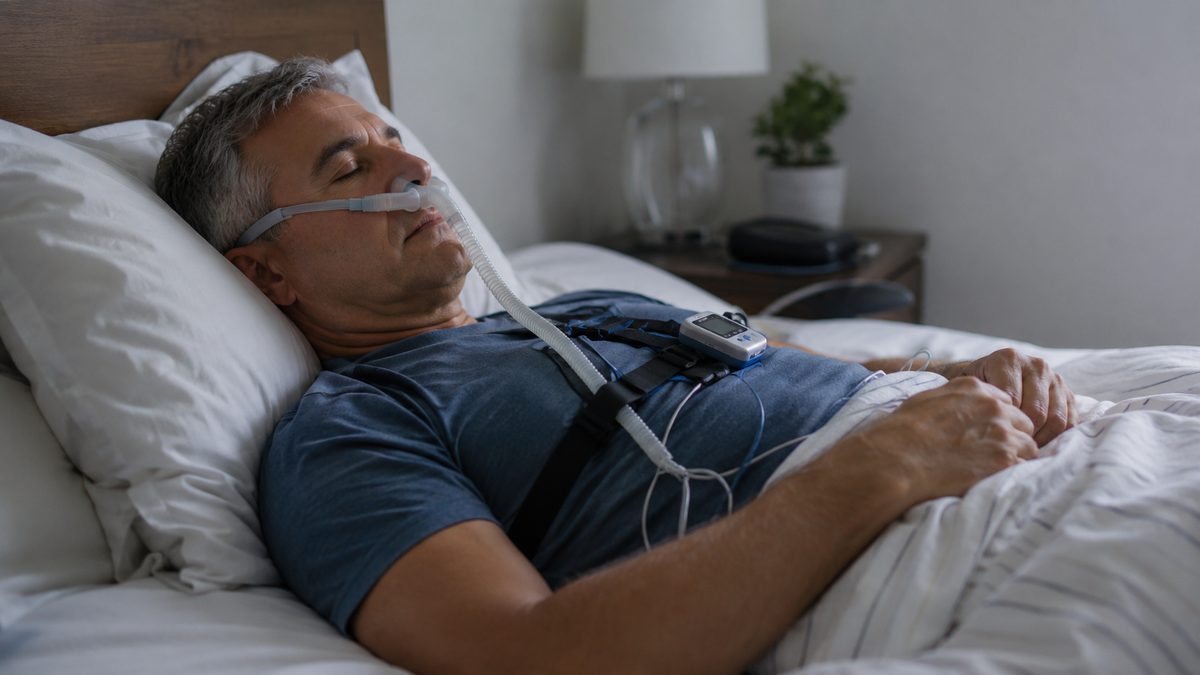
A home sleep test is a simplified version of in-lab polysomnography. Instead of electrodes measuring brain waves, eye movement, and dozens of other signals, a home device typically tracks:
- Airflow through the nose and mouth
- Blood oxygen levels via pulse oximetry
- Chest movement and breathing effort
- Heart rate
- Body position in some devices
You wear it overnight, return it, and a sleep physician reviews the data. The device produces a respiratory event index, or REI, which counts breathing disruptions per hour of recording time. This is different from the apnea-hypopnea index, or AHI, that a lab measures. And that difference matters.
A 2024 analysis of 1,561 sleep recordings found that REI consistently underestimates sleep apnea severity compared to AHI, with classification accuracy for severity ranging from only 42 to 73%. The reason is mechanical: a home device records total time with the equipment on, not actual sleep time. If you lay awake for an hour before falling asleep, those events are averaged over a longer window, making your apnea look milder than it is.
What Is the 4% Rule for Sleep Apnea?
The 4% rule refers to how home devices and labs define a hypopnea, a partial breathing reduction rather than a full stop. A 4% oxygen desaturation rule means a breathing event is only counted if your blood oxygen drops by 4% or more during it.
Labs sometimes use a 3% desaturation threshold, which catches more events and produces a higher AHI. Home devices typically default to the 4% rule, which counts fewer events. If you're right on the border of mild and moderate sleep apnea, the scoring rule can change your diagnosis entirely.
This is one of the details most articles skip. When I found this out, it explained why some people get conflicting results between home and lab tests. A client of mine had a home test come back at an REI of 12, borderline moderate. His lab test came back at an AHI of 19, clearly moderate, requiring treatment. Same person, same night of breathing, different tools and different rules.
When Is a Home Test Accurate Enough?
Home tests work best when the pre-test probability is high. That means you already have strong symptoms pointing toward obstructive sleep apnea, and you don't have complicating health conditions.
A 2022 meta-analysis of 13 studies with over 1,200 participants found home testing using peripheral arterial tonometry hit 96% sensitivity for detecting sleep apnea at a lower threshold. In practical terms: if you have sleep apnea, a home test will almost certainly catch it. The problem is the 44% specificity at that same threshold, meaning a lot of people without sleep apnea also get flagged as positive.
At higher severity thresholds, specificity improves to around 74%, which is why a positive home test for someone with obvious symptoms is much more reliable than a borderline result in someone with mild symptoms.
A randomized controlled trial comparing a portable home monitor to in-lab polysomnography found fair agreement between the two methods, with sensitivity of 86 to 89% but specificity of only 38 to 44%. Home tests catch almost everyone who has sleep apnea. They also catch a lot of people who don't.
Who Should Skip the Home Test and Go Straight to a Lab?
Some people need a full in-lab polysomnography from the start. Go directly to a sleep lab if you have:
- Heart failure or significant heart disease
- Moderate to severe lung disease
- Suspected central sleep apnea, which is where the brain fails to send the signal to breathe rather than the airway being physically blocked
- Neuromuscular disease affecting breathing
- A previous home test that came back negative despite strong symptoms
Central sleep apnea requires different treatment from obstructive sleep apnea. A standard CPAP machine, which works by keeping the airway open with continuous positive airway pressure, may not help and can sometimes worsen central apnea. A home device can't reliably tell the difference between the two types.
If there's any reason to suspect central sleep apnea, the EEG and full monitoring of an in-lab polysomnography is the right starting point.
What Happens If You Treat Based on a Home Test?
For straightforward obstructive sleep apnea, treating based on a home test result is standard practice and it works. CPAP therapy, mandibular advancement splints, and positional therapy are all commonly started after a home test in appropriate candidates.
A 1999 cost-utility analysis found that in-lab polysomnography produced better long-term outcomes in terms of quality-adjusted life-years, suggesting that diagnostic accuracy does affect how well treatment works over time. That research is older, and home devices have improved significantly since then. But the principle holds: a wrong diagnosis leads to wrong treatment.
The practical upside of home testing is speed. Results in 3 to 7 days versus weeks on a waiting list for a sleep lab. For moderate to severe sleep apnea, that speed matters. Untreated sleep apnea at that severity raises cardiovascular risk. Getting on CPAP faster, even based on a home test, is better than waiting.
What Most Articles Get Wrong About Home Sleep Testing
Most articles either oversell home tests as good enough for everyone, or dismiss them as too inaccurate to bother with. Both are wrong.
First: the false positive problem is under-discussed. Because home tests are so sensitive, a positive result in someone with mild or atypical symptoms can lead to unnecessary CPAP treatment. CPAP isn't harmful, but it's not trivial either. It takes weeks to adjust to, affects sleep quality during that adjustment, and costs money. Starting someone on CPAP who doesn't need it is a real outcome of over-relying on home test results.
Second: most people don't know about the REI versus AHI difference. Your home test number and your lab test number aren't the same metric. Comparing them directly is like comparing kilometres per hour to miles per hour and wondering why the numbers are different. A sleep physician should interpret both results, not the patient alone.
Third: pulse oximetry alone, which some people use as a cheap DIY approach, gives you a rough signal but not a diagnosis. Oxygen desaturation index from a wrist oximeter can suggest sleep apnea, but multi-channel home devices that also measure airflow and chest effort are significantly more informative. A wrist oximeter from a pharmacy isn't a sleep test.
Frequently Asked Questions
Can I use a smartwatch or fitness tracker to test for sleep apnea?
Consumer wearables can flag irregular breathing or low oxygen overnight, but they're not validated diagnostic tools. They can prompt you to seek a proper test, which is useful. They can't diagnose or rule out sleep apnea.
How much does a home sleep test cost?
In Australia, home sleep tests through a sleep physician typically range from $150 to $400 depending on the device and whether Medicare rebates apply. In-lab polysomnography costs more but may also attract rebates. A GP referral is the first step either way.
Can children do a home sleep test?
No. Pediatric sleep apnea requires in-lab polysomnography. Children have different breathing patterns and causes, and home devices aren't validated for use under 18.
If my home test is negative, do I have sleep apnea?
Not necessarily. If your symptoms are strong, a negative home test result should be followed up with an in-lab study. The high sensitivity of home tests means most real cases are caught, but some are missed, particularly milder or positional cases.
What is the difference between obstructive and central sleep apnea?
Obstructive sleep apnea is caused by the throat physically collapsing during sleep. Central sleep apnea is caused by the brain not sending the signal to breathe. Home tests are designed for obstructive sleep apnea. They're not reliable for central sleep apnea diagnosis.
Can natural or complementary approaches help with sleep apnea?
Some people find that approaches addressing inflammation, nasal congestion, and nervous system regulation support better sleep and reduce symptom severity. These work alongside, not instead of, a proper diagnosis. Getting tested first tells you what you're actually dealing with.
Your Next Step
If you have snoring, witnessed pauses, and persistent daytime tiredness, book a home sleep test through your GP this week. A result in 3 to 7 days is far better than months of poor sleep while you wait.
If your home test comes back positive and your symptoms are clear, work with your doctor on a treatment plan. If it comes back negative and your symptoms are still strong, push for an in-lab study. Don't let a single number on a home device be the end of the conversation.
Sources
Continue with the Sleep article archive collection.

What Are 10 Signs That My Body Is Healthy?
Read article →
How to Tell if Your Body Is Unhealthy?
Read article →
What Are Signs of Poor Function Health?
Read article →
What Are Some Weird Signs That My Body Is Healthy?
Read article →
What Are Five Signs That I Might Not Be Healthy?
Read article →