What Is the 4% Rule for Sleep Apnea? The Diagnostic Threshold Explained
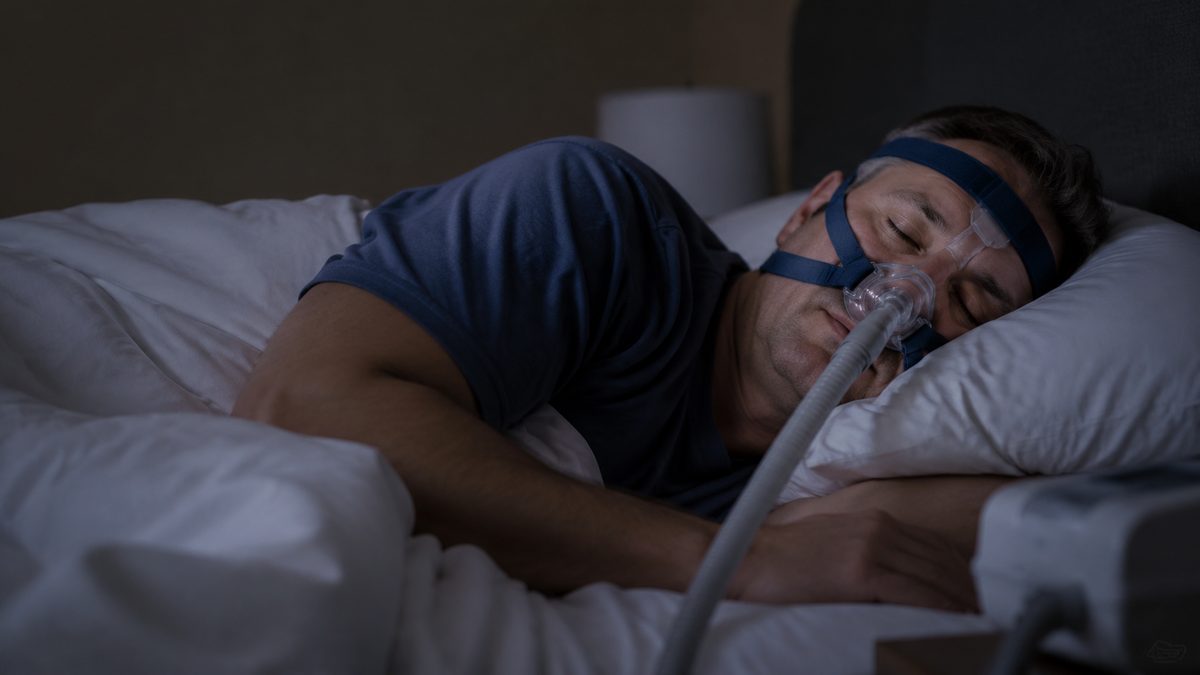
The 4% rule is simple: a breathing event only counts if your blood oxygen drops by at least 4% from your baseline level. That's it. That one threshold determines your apnea-hypopnea index (AHI), which is the number your doctor uses to decide whether you have sleep apnea and how severe it is.
If your oxygen dips by 3.9%, the event doesn't count. If it drops by 4%, it does. That distinction shapes everything that follows, your diagnosis, your treatment, whether you get a CPAP machine or not.
The 4% rule works well as a screening tool in practice. Research on over 3,400 sleep recordings found that an oxygen desaturation index using the 4% threshold predicted clinically significant sleep apnea with 97.7% sensitivity and 97.0% specificity. But here's the catch: the 4% threshold is a diagnostic convention, not a perfect physiological boundary. How deeply and how long your oxygen drops may matter more for long-term heart risk than how often it drops.
What Exactly Happens to Your Oxygen During Sleep Apnea?
When you stop breathing during sleep, your airway either fully collapses (an apnea) or partially collapses (a hypopnea). Both cut oxygen supply to your blood. Your brain eventually forces you to rouse slightly and resume breathing, usually without you knowing it happened.
Your blood oxygen level, measured as SpO2, normally sits between 95% and 100% when you're awake. During an obstructive sleep apnea event, it can drop well below 90%. The 4% rule says: if the drop from your stable baseline reaches 4 percentage points or more, it counts as a scored event.
The oxygen desaturation index (ODI) counts how many of these 4% drops happen per hour of sleep. When researchers compare ODI to AHI, they track almost identically. An ODI of 5 or more per hour using the 4% criterion identifies clinically significant sleep apnea with a positive predictive value above 99%. That's why a simple home pulse oximeter can flag the condition before you ever set foot in a sleep lab.
How Many Apneas Per Night Are Considered Severe?
Severity is measured by AHI, which counts breathing interruptions per hour of sleep. The standard clinical thresholds are:
- Mild: 5 to 14 events per hour
- Moderate: 15 to 29 events per hour
- Severe: 30 or more events per hour
Someone with severe sleep apnea stops breathing at least 30 times every hour. Every two minutes. Across a seven-hour night, that's 210 or more events. One of my clients came back from her sleep study with an AHI of 52. She'd been told for years she was just a heavy snorer.
When she saw that number, she finally understood why she'd woken up exhausted for a decade despite being in bed eight hours.
At the severe end, oxygen can drop repeatedly below 85%, and some people dip into the 70s. These prolonged, deep drops reveal the limitation of simple event counting. Two people can both have an AHI of 35, but one may be having brief, shallow dips while the other sustains long, deep ones. Their cardiovascular risk profiles are not the same.
What Does the 4% Rule Actually Miss?
This is where most articles stop short. And it matters.
The 4% rule counts frequency. It doesn't measure depth or duration. A newer concept called hypoxic burden addresses this gap. Instead of just counting events, hypoxic burden calculates the total area under the oxygen desaturation curve, integrating both how far oxygen dropped and for how long. Research suggests hypoxic burden may identify people at higher cardiovascular risk more effectively than AHI or ODI alone.
Think of it this way. Two patients both have 20 events per hour. Patient A's oxygen drops to 93% for 10 seconds each time. Patient B's oxygen drops to 78% for 45 seconds each time. Their AHI is identical. Their oxygen load on the heart and brain is not.
Desaturation patterns, not just event frequency, correlate differently with cardiovascular outcomes like hypertension and heart failure. This is why some studies of CPAP therapy show strong cardiovascular benefit while others show modest results. If the trial population was selected by AHI alone, it may have mixed together people with very different actual oxygen stress.
Why Single-Night Tests Can Get It Wrong
Your AHI on one night can differ significantly from your AHI the next night. This isn't a small measurement error. In a simulation of nearly 4,000 participants, single-night AHI produced inconsistent associations with incident hypertension compared to multi-night averaging. The variability is real enough to misclassify people as normal or mild when they're actually moderate, or vice versa.
This happened to a client of mine who did a home sleep test and came back with an AHI of 8, which fell in the mild category. He still felt terrible and pushed for a second study. His second night showed an AHI of 24. He actually had moderate to severe OSA. One test would have left him undertreated.
If your test comes back borderline, ask your sleep specialist about multi-night monitoring or a full in-lab polysomnography. Polysomnography records not just oxygen but brain waves, eye movement, muscle activity, heart rate, and breathing effort simultaneously, giving a far more complete picture than a home oximeter can.
What Is the 3-3-2 Rule for Sleep Apnea?
You may have seen references to a "3% rule" alongside the 4% rule. This refers to an alternative scoring threshold where an event is counted if oxygen drops by 3% instead of 4%, combined with an arousal from sleep. Some sleep labs and some international guidelines use the 3% criterion, which tends to produce higher AHI scores because it captures more events.
The difference matters clinically. A person scored under 3% criteria might qualify as moderate. The same person scored under 4% criteria might fall in the mild range. Neither system is universally accepted as the gold standard. In my experience, patients are rarely told which threshold their test used, and comparing results across different clinics can be confusing when they used different rules.
If your AHI sits near a category boundary, ask which desaturation threshold was applied. It can change your diagnosis category and your treatment options.
What Is the Japanese Trick for Sleep Apnea?
This phrase circulates widely online and usually refers to sleeping position, specifically side sleeping. The Japanese practice of semui, or lateral sleeping posture, has been associated with reduced apnea frequency because it prevents the tongue and soft palate from falling back and collapsing the airway. Positional sleep apnea is a real subtype where AHI drops significantly in non-supine positions.
What I found was that positional therapy works well for people whose AHI is at least twice as high on their back compared to their side. For these individuals, something as simple as sewing a tennis ball into the back of a sleep shirt can cut events per hour dramatically. It's not a cure, but for mild to moderate positional OSA, it's a legitimate first-line option that costs almost nothing.
"Japanese trick" as a concept has been exaggerated in some corners of the internet into something more exotic than it is. The evidence supports positional therapy as a real, useful tool. It doesn't support any single secret technique as a universal fix.
What Is the New Pill for Sleep Apnea?
In 2024, tirzepatide became the first medication to receive clinical trial evidence for reducing AHI in obstructive sleep apnea. The SURMOUNT-OSA trial showed significant AHI reductions in people with obesity-related OSA. The drug works primarily by driving weight loss, and weight loss is one of the most effective ways to reduce OSA severity in people who are overweight.
This isn't a standalone sleep apnea medication in the traditional sense. It targets the upstream driver, excess weight, rather than the airway mechanics directly. For patients who can't tolerate CPAP or who have significant obesity alongside their diagnosis, it represents a meaningful option worth discussing with a doctor.
It's also worth pointing out what it's not. It's not a replacement for CPAP in people with severe OSA. It doesn't work for everyone. And for people whose sleep apnea has other causes, such as airway anatomy, it may provide limited benefit regardless of weight change.
What the 4% Rule Means for How You Get Treated
Your AHI, calculated using the 4% threshold, determines which treatments your doctor will recommend. Below 5 events per hour, no diagnosis. Between 5 and 14, lifestyle changes and possibly positional therapy or a mandibular advancement device. Above 15, CPAP is usually the first recommendation. Above 30, CPAP is nearly always recommended regardless of symptoms. treatment options
The problem is that this clean progression assumes the AHI accurately reflects your physiological burden. As the evidence shows, it often doesn't. Someone with an AHI of 12 but severe hypoxic burden may carry more cardiovascular risk than someone with an AHI of 22 but brief, shallow events.
This is one of the most underappreciated problems in sleep medicine right now. The diagnostic system was built around a metric that was practical to measure in the 1970s. The field is only beginning to shift toward burden-based and multi-night assessments.
FAQ
Does a low AHI mean I definitely do not have sleep apnea?
Not necessarily. A low AHI on a single home test can miss real OSA due to night-to-night variability. If your symptoms are strong, push for repeat testing or a full polysomnography.
Can I check the 4% rule at home?
A pulse oximeter worn overnight records your oxygen saturation and flags drops of 4% or more. This gives you an ODI, which correlates closely with AHI. It's a useful screening tool but not a substitute for a formal sleep study.
Is a higher AHI always more dangerous?
Not always. The depth and duration of oxygen drops matter alongside frequency. Hypoxic burden, not just AHI, appears to better predict cardiovascular risk.
What if my AHI is on the borderline between categories?
Ask which desaturation threshold (3% or 4%) was used in your study, whether it was a single-night or multi-night measurement, and whether hypoxic burden was assessed. Borderline results deserve a closer look.
Does sleep apnea go away on its own?
Rarely, without intervention. Significant weight loss, positional therapy for positional OSA, or structural changes from surgery can reduce severity. For most people, it's a chronic condition that requires ongoing management.
What to Do With This Information
The 4% rule is the entry point into sleep apnea diagnosis, not the whole picture. If your home oximetry shows an ODI of 5 or more, treat that as a strong signal to get a formal evaluation. If you've been diagnosed and your AHI sits near a category boundary, or if you still feel unwell despite treatment, ask about multi-night monitoring and hypoxic burden assessment. The number on your sleep report is a starting point for the conversation, not the end of it.
Three action points:
- If you snore, wake unrefreshed, or have been told you stop breathing at night, get an overnight oximetry test first. An ODI of 5 or more on the 4% criterion means you almost certainly have clinically significant OSA.
- If your test result lands near a severity boundary (AHI around 15 or around 30), ask specifically which threshold was used and request a second-night measurement or full polysomnography before accepting the classification.
- Ask your sleep specialist whether hypoxic burden data is available from your study, particularly if you have cardiovascular risk factors. Event frequency alone may underestimate your true risk.

Sources
- Martinez-Garcia MA, Sánchez-de-la-Torre M, White DP, Azarbarzin A (2023) "Hypoxic Burden in Obstructive Sleep Apnea: Present and Future" Archivos de bronconeumologia. PMID: 36115739
- Peker Y, Hjälm H, Glantz H, Pihtili A, Thunström E (2026) "Oxygen desaturation index and apnea–hypopnea index in relation to incident heart failure: The sleep apnea patients in Skaraborg study" Sleep Medicine. DOI: 10.1016/j.sleep.2026.108991
- Kapoor M (2018) "Discrepancy Between Oxygen Desaturation Index and Apnea-Hypopnea Index: What Do You Do With the Results?" Journal of Clinical Sleep Medicine. DOI: 10.5664/jcsm.7296
- Blekic N, Bold I, Mettay T, Bruyneel M (2022) "Impact of Desaturation Patterns versus Apnea–Hypopnea Index in the Development of Cardiovascular Comorbidities in Obstructive Sleep Apnea Patients" Nature and Science of Sleep. DOI: 10.2147/nss.s374572
- Fabius TM, Benistant JR, Bekkedam L, van der Palen J, de Jongh FHC, Eijsvogel MMM (2019) "Validation of the oxygen desaturation index in the diagnostic workup of obstructive sleep apnea" Sleep & breathing = Schlaf & Atmung. PMID: 29564732
- Lechat B, Nguyen DP, Reynolds A, Loffler K, Escourrou P, McEvoy RD, et al. (2023) "Single-Night Diagnosis of Sleep Apnea Contributes to Inconsistent Cardiovascular Outcome Findings" Chest. PMID: 36716954
- Jamil S, Kachechian T, Armache M, Alapati R, Tsao J, Huntley C, et al. (2022) "0721 Correlation between Oxygen Desaturation Index and Apnea Hypopnea Index for Diagnosis of Obstructive Sleep Apnea" Sleep. DOI: 10.1093/sleep/zsac079.717
- Alapati R (2023) "Correlation between Desaturation Event Index and Apnea Hypopnea Index for Diagnosis of Obstructive Sleep Apnea" Journal of Otolaryngology and Rhinology Research. DOI: 10.52845/jorr/2023/4.4.1
Continue with the Sleep article archive collection.

What Are 10 Signs That My Body Is Healthy?
Read article →
How to Tell if Your Body Is Unhealthy?
Read article →
What Are Signs of Poor Function Health?
Read article →
What Are Some Weird Signs That My Body Is Healthy?
Read article →
What Are Five Signs That I Might Not Be Healthy?
Read article →