What Is the Pillow Trick for Sleep Apnea? Here's What Actually Works
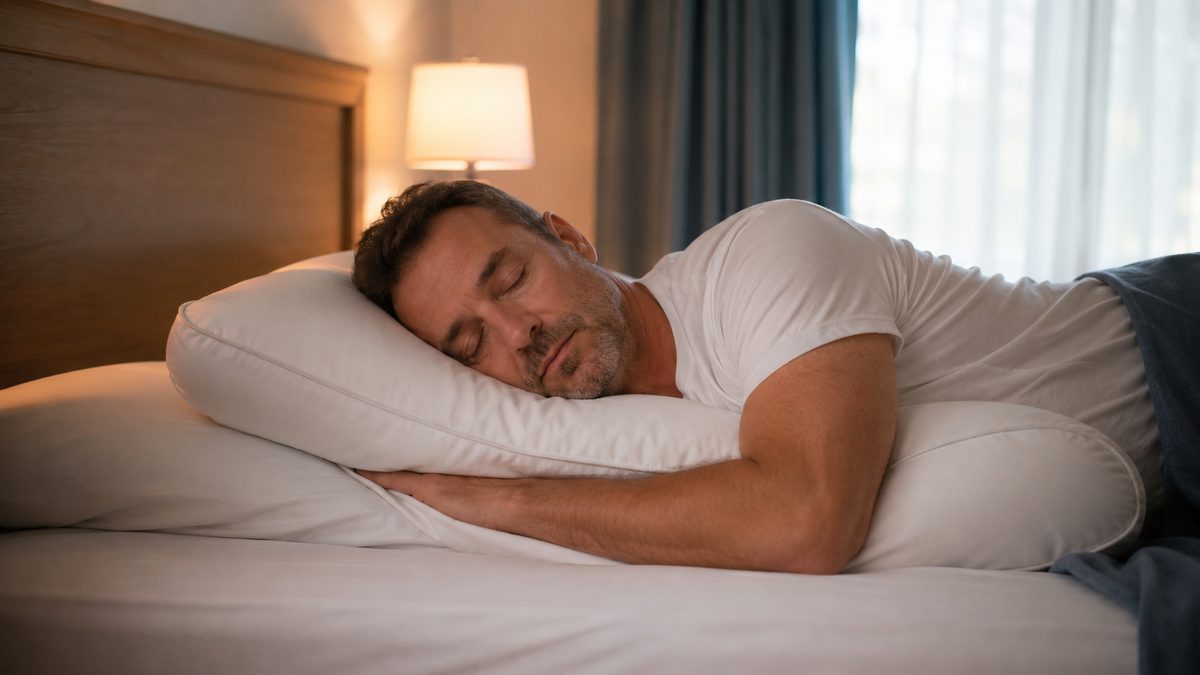
The pillow trick for sleep apnea means using a specially designed positioning pillow to keep you sleeping on your side instead of your back. For people whose apnea gets worse when lying flat on their back, this one change can reduce airway blockages from the first night.
It works best for mild to moderate cases where your apnea events roughly double when you roll onto your back. It's not about stacking regular pillows higher. That doesn't fix the problem.
Why Does Sleeping Position Matter So Much?
When you lie on your back, gravity pulls the soft tissue in your throat downward. Your tongue, soft palate, and the muscles around your airway all sag toward the back of your throat. For someone with obstructive sleep apnea, that narrowing is enough to cause repeated blockages through the night.
Roughly 25 to 55 percent of people with obstructive sleep apnea have what researchers call positional sleep apnea. Their apnea-hypopnea index (AHI), the count of breathing interruptions per hour, is at least twice as high when sleeping on their back compared to their side. If you're in this group, your position is doing a large part of the damage.
One of my clients came in convinced she had severe sleep apnea. Her partner said the snoring was constant. When her sleep study came back, her AHI on her back was 38 events per hour. On her side, it dropped to 9. Same airway. Different angle.
What Does the Pillow Trick Actually Involve?
A true positional pillow is engineered to make back-sleeping physically uncomfortable or mechanically difficult. Most have a raised central ridge or contoured shape that prevents you from rolling fully onto your back during sleep. Some are worn like a vest or chest harness. The goal is the same: keep you on your side without waking you up.
This is different from a regular pillow propped behind your back. A standard pillow shifts around. You roll over it without noticing. Positional pillows are designed to stay in place and create consistent resistance all night.
A 2018 study with 28 patients found that a positioning pillow produced immediate improvements in sleep apnea severity after just one night, and those benefits held steady at one month. A 2025 randomized trial comparing positioning pillows to vibrating belts found both approaches reduced time spent sleeping on the back, with pillows showing strong use at home.
Do Sleep Apnea Pillows Really Work?
For the right person, yes. They work. The Cochrane review on positional therapy confirmed it is a legitimate, less invasive option to CPAP for people with positional obstructive sleep apnea. The honest caveat is that long-term adherence data is still limited, and these pillows aren't a universal fix.
People who benefit most share a few traits. They have a clear positional component confirmed by a sleep study. Their overall AHI on their side is in the mild to moderate range. They want to avoid CPAP or have tried it and struggled with the machine.
People who don't benefit are those whose AHI stays high regardless of position, or those with severe apnea where even side-sleeping leaves them with dangerous breathing interruptions. For those people, CPAP or another intervention is necessary, not optional.
What Is the 4% Rule for Sleep Apnea?
The 4% rule refers to how oxygen desaturation events are scored during a sleep study. An apnea or hypopnea event counts in your AHI score if it causes your blood oxygen to drop by at least 4% from baseline. Some sleep labs use a 3% threshold. The number you end up with varies depending on which rule is applied, which is why two sleep studies from different places can give you different AHI scores even if your actual breathing is the same.
This matters because your classification as mild, moderate, or severe apnea, and therefore which treatments are appropriate, depends on that score. If your AHI sits close to a threshold, ask your sleep physician which desaturation rule was used.
What Do Japanese Methods for Sleep Apnea Look Like?
Japanese sleep research and clinical practice have explored positional therapy, specific pillow designs, and low-profile jaw advancement devices as first-line options before CPAP, particularly for mild cases. A 2011 study from Korean and Japanese researchers specifically examined positional therapy as a standalone treatment for positional obstructive sleep apnea and found meaningful reductions in AHI through sleeping position alone.
The broader approach emphasizes identifying positional dependence early through a proper sleep study, then offering the least invasive effective option first. A cervical support pillow that maintains neutral neck alignment while keeping the airway open is one tool used in this framework. It's not magic. It's applied physiology.
Who Should Try the Pillow Trick First?
You're a good candidate if a sleep study confirms your apnea is positional, meaning your AHI on your back is at least double your AHI on your side. You're also a better candidate if your side AHI is under 15, placing you in mild to moderate territory.
Try it if CPAP didn't work for you. Many people find the mask intolerable, especially at first. Positional therapy is a real clinical option, not a consolation prize. Research comparing it directly to CPAP shows it performs well for positional patients who actually use it consistently.
One of my clients spent eight months fighting with his CPAP. Mask leaks, dry mouth, waking up at 3am pulling the thing off. His positional AHI difference was significant: 32 on his back, 11 on his side. We switched him to a positioning pillow and a chin strap. Six weeks later his partner stopped sleeping in the spare room.
Three Things Most Articles Get Wrong About This
First: height does not fix position. The most common version of the pillow trick online is to prop your head up higher with extra pillows. This does almost nothing for airway obstruction caused by back-sleeping. Elevation can marginally help some people with mild reflux issues, but it doesn't move the tongue and soft palate out of the airway. Lateral positioning does that.
Second: this only works if your apnea is actually positional. Treating positional apnea with a positioning pillow makes sense. Treating non-positional apnea with one is like trying to fix a leaking pipe by changing the tap handle. If your sleep study shows your AHI stays high regardless of position, a pillow won't help and you need a different treatment.
Third: positional therapy isn't just a first step toward CPAP. Some practitioners treat it as a bridge. For mild to moderate positional apnea, it can be the endpoint. A systematic review in Sleep Medicine Clinics confirmed it as a viable standalone therapy for appropriate patients. If it resolves your symptoms and your follow-up study confirms improvement, you don't need to escalate.
How Long Before You Know If It Is Working?
You'll likely notice a change in the first week. Your partner may notice before you do. Snoring reduces, sleep feels less broken, and you wake up less groggy.
The evidence from positioning pillow studies suggests benefits are detectable from night one and stable at one month. If you've seen no improvement in four to eight weeks of consistent use, the pillow isn't the right tool for your specific case. That's not a failure. It's information. Go back to your sleep physician and discuss what comes next.
What Else Can Support Positional Sleep Therapy?
A few things work alongside positional pillows rather than replacing them.
- Mandibular advancement devices hold your jaw slightly forward, which also moves the tongue base away from the airway. For mild apnea these can be combined with positional therapy for added benefit.
- Weight management reduces the tissue mass around the airway and lowers AHI across all positions. It's not a quick fix but it addresses an underlying driver.
- Avoiding alcohol before bed matters more than most people realize. Alcohol relaxes the throat muscles and turns positional apnea into non-positional apnea for a few hours. One client who was doing well with his pillow kept having bad nights. The only variable we could find was a glass of wine at dinner.
- Nasal breathing exercises and myofunctional therapy are gaining traction for mild cases. They target the muscle tone of the upper airway and take months to work, but the results can be durable.
Frequently Asked Questions
Can a regular pillow work as a substitute?
No. Regular pillows move and compress during sleep. They don't maintain consistent positional resistance all night. If you want to test whether side-sleeping helps before buying a specialized pillow, sew a tennis ball into the back of a sleep shirt. It's uncomfortable enough to stop you rolling onto your back and it gives you real data on whether position is your problem.
Is positional therapy safe for everyone?
For most people, yes. If you have neck problems, shoulder injuries, or significant acid reflux, check with your doctor before committing to a fixed side-sleeping position. Some people find lateral sleeping aggravates shoulder pain over time, which then disrupts sleep in a different way.
Does the pillow trick work for central sleep apnea?
No. Central sleep apnea is a neurological issue where the brain fails to send the right signals to breathing muscles. It's not caused by airway obstruction. Positional therapy addresses obstructive apnea only.
How do I know if my apnea is positional?
A full overnight sleep study will record your AHI separately by position. If your back AHI is at least double your side AHI, you have positional apnea. Some home sleep tests also capture this, though they're less accurate for position-specific scoring.
Can children use positional pillows for sleep apnea?
Pediatric sleep apnea most often has structural causes like enlarged tonsils or adenoids. Positional therapy isn't the standard approach for children. A pediatric sleep specialist should assess any child suspected of having sleep apnea.
Where does homeopathy fit with sleep apnea?
Homeopathic support can be used alongside positional and lifestyle approaches, particularly where sleep quality, nervous system regulation, or underlying contributors like chronic nasal congestion are part of the picture. It works best as part of an integrated approach rather than as a standalone treatment for diagnosed apnea.
What to Do Now
If you suspect positional sleep apnea, get a sleep study first. Treating a guess isn't a plan. Once you know your positional AHI data, you have the information to decide whether a positioning pillow is the right move or whether you need something more.
If the study confirms positional apnea and your side AHI is in the mild to moderate range, try a proper contoured positioning pillow for four to six weeks. Track whether your snoring reduces, your partner reports fewer pauses, and you wake up feeling more rested. Those three signals together are your real outcome measure.
If symptoms persist after six weeks of consistent use, go back to your sleep physician. You haven't failed. You've ruled out one option and narrowed the field.
Sources

What Are 10 Signs That My Body Is Healthy?
Read article →
How to Tell if Your Body Is Unhealthy?
Read article →
What Are Signs of Poor Function Health?
Read article →
What Are Some Weird Signs That My Body Is Healthy?
Read article →
What Are Five Signs That I Might Not Be Healthy?
Read article →